The KP index measures geomagnetic disturbance on a scale from 0 to 9. Higher values mean stronger geomagnetic storms and better chances of seeing aurora at lower latitudes. A KP of 5 or above is classified as a geomagnetic storm. The index is updated every 3 hours by NOAA's Space Weather Prediction Center.
LIVE · NOAA SWPC · 22:38 UTC
Aurora forecast
for the next 48 hours.
Real-time KP index, solar wind telemetry and the OVATION aurora oval — direct from NOAA's Space Weather Prediction Center.
Current KP Index
–.–
/9.0
Source: NOAA SWPCUpdated every 3 hours
48-Hour Forecast
Geomagnetic activity, every 3 hours.
Observed and predicted KP values from NOAA's planetary K-index forecast.
KP Timeline
3-Day Geomagnetic Outlook
——
—
—
——
—
—
——
—
—
Solar Wind
Bz Component
—nT
Bt Total
—nT
Speed
—km/s
Density
—p/cm³
Imagery
Where the lights will appear.
NOAA's official viewline maps and OVATION oval — switch between tonight, tomorrow and each pole.
The Science
From the Sun to your sky.
Every aurora is a 150-million-kilometre journey. Here's what we measure along the way.
01
Solar wind
The Sun continuously ejects charged particles. CMEs and high-speed streams push energy toward Earth.
02
L1 telemetry
Spacecraft at the L1 Lagrange point measure speed, density and Bz — giving us 30–60 minutes of warning.
03
Magnetosphere
When Bz turns south, particles funnel along Earth's field lines toward the polar regions.
04
Aurora visible
Excited oxygen and nitrogen atoms emit light at 100–300 km altitude — the dancing curtains we see.
The KP Scale
0 quiet · 9 extreme123456789
3D Globe
Aurora oval, three dimensions.
Mobile App · Android iOS version coming soon
The aurora, in your pocket.
Real-time alerts, personalized forecasts, and a 3D aurora globe. Available for Android.
- Push alerts when KP exceeds your threshold
- Cloud cover & visibility per location
- 3D aurora globe in your pocket
- Personal forecast for your viewing spot
iOS version coming soon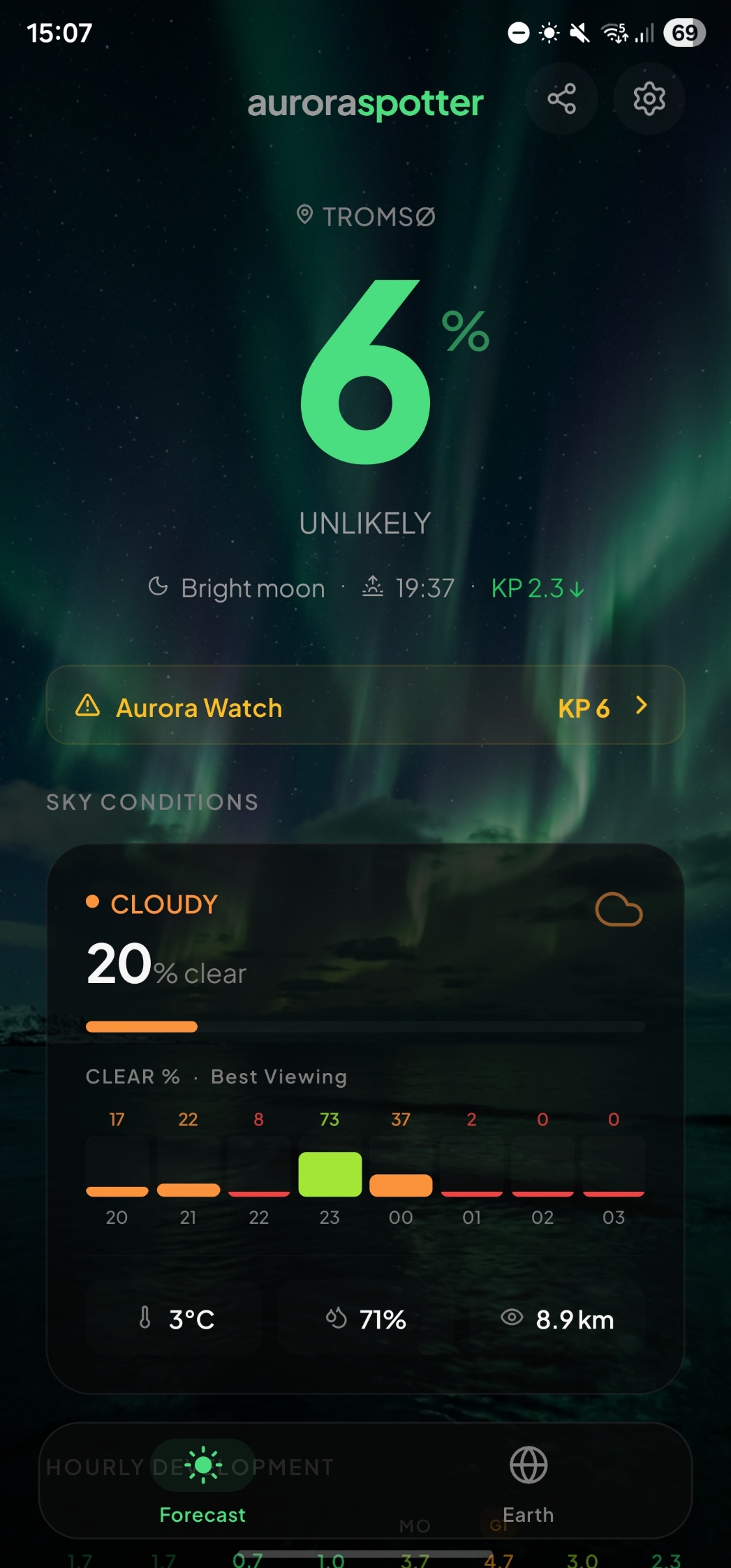
FAQ
Common questions.
Everything you might wonder about KP, solar wind, and northern lights.
Practical Guide
How to actually see the northern lights.
Forecasts get you halfway. The other half is knowing where to be, when to go, and what to expect when you get there.
Where you can see them
The aurora forms in a roughly circular ring centred on each magnetic pole — the so‑called auroral oval. The further north you are inside that ring, the lower the KP index needed to see anything overhead. Below the ring, you're looking toward the lights on the horizon, which means you need a stronger storm to push the oval far enough south.
Tromsø, Reykjavík, Fairbanks65–70° NKP 1+
Trondheim, Helsinki, Whitehorse60–65° NKP 3+
Edinburgh, Stockholm, southern Norway55–60° NKP 5+
Hamburg, Manchester, northern US50–55° NKP 6+
Munich, London, New York45–50° NKP 7+
Madrid, Rome, Atlanta40–45° NKP 8+
These are rules of thumb, not guarantees. A KP 5 storm at midnight in clear skies can light up southern Norway; a KP 7 at 4 a.m. with overcast skies anywhere will give you nothing.
When to go
Aurora season runs from September to March in the northern hemisphere — when nights are dark enough for the lights to show. Around the equinoxes (late September and late March), geomagnetic activity tends to be 30–50% higher on average, a pattern called the Russell–McPherron effect. That makes September–October and February–March statistically the best windows.
On any given night, the most active period is from about 10 p.m. to 2 a.m. local time, when your location passes through the part of the magnetosphere most exposed to the solar wind.
We're currently near Solar Cycle 25 maximum — the Sun is more active than it's been in two decades. That means more frequent and stronger geomagnetic storms through 2025–2027 than at any point in the past 20 years.
What you actually need
The forecast can be perfect and you'll still see nothing if any of these are off:
- Clear sky. Cloud cover is the single most common reason a hunt fails. Check a cloud‑cover map for your spot, not just for the whole region.
- Dark sky. Get away from city lights — even a 20-minute drive matters. The aurora is faint compared to a streetlamp.
- An unobstructed northern horizon. If you're at lower latitudes, the lights stay near the northern horizon. Trees, buildings, and hills will hide them.
- Time and patience. Aurora pulses. A weak hour can suddenly become a strong one. Plan to stay out for at least 1–2 hours.
- Warm clothes. Standing still in sub‑zero air for two hours is colder than you think. Layer up properly.
What you'll see (and what the camera sees)
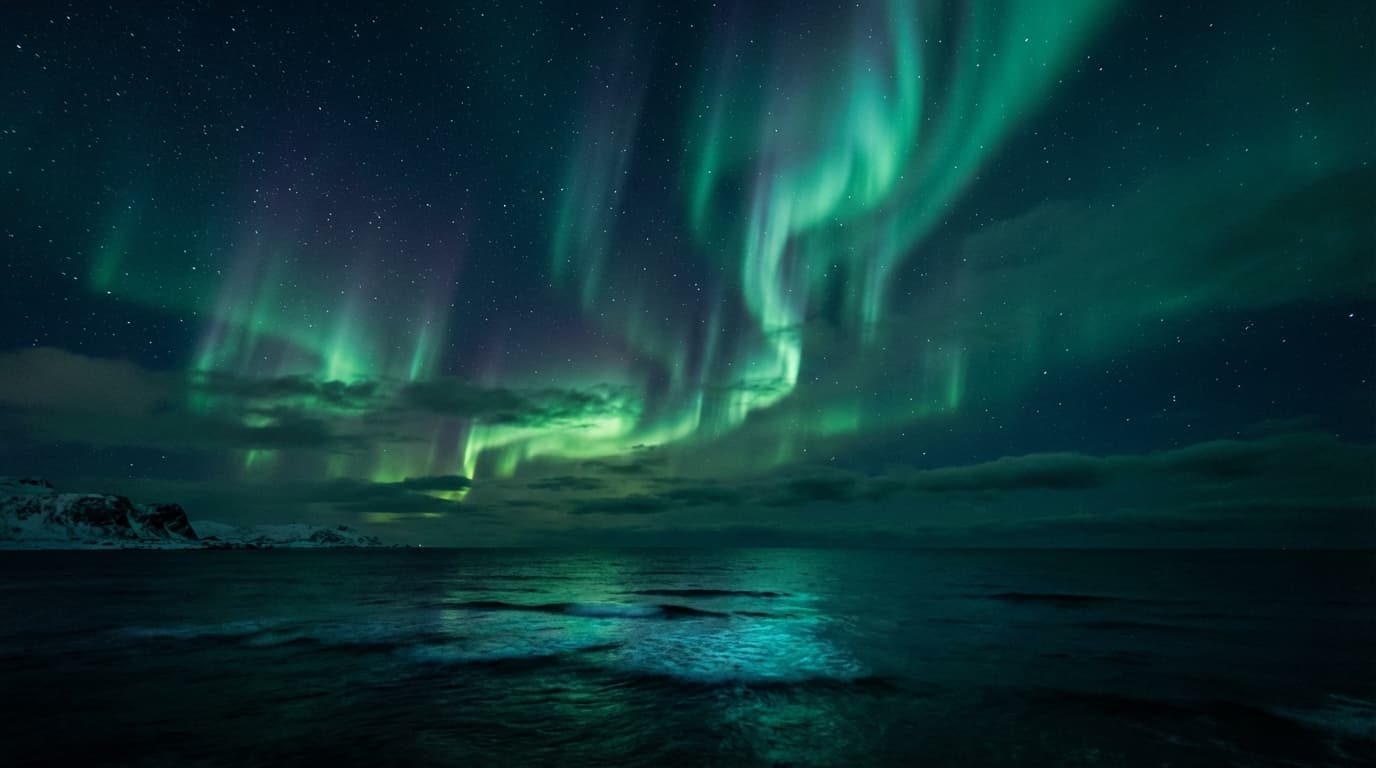
Modern phone cameras are dramatically more sensitive than your eyes. A faint glow that looks like grey haze to you can render as a vivid green curtain in a 3‑second exposure. This isn't the camera lying — both are real, just different. Your eye sees what's there in real time; the camera accumulates light over seconds.
The colours come from different gases in the upper atmosphere. Green dominates because oxygen at 100–200 km altitude emits at 558 nm. Red is also oxygen, but at higher altitudes (200–400 km) where it's rarer — that's why red aurora is the signature of a strong storm. Purple and pink edges come from nitrogen at the lower edge of the curtains.
Naked‑eye aurora at lower latitudes often looks like a slowly shifting grey or pale-green glow on the northern horizon, sometimes with vertical streaks. To see vivid dancing curtains, you usually need to be inside the auroral oval at higher latitudes — or catch an extreme storm.
Reading the data on this page
The KP index is the headline number — a 0–9 scale measured globally every 3 hours. But for serious hunters, the more useful real‑time signal is the solar wind Bz component: when Bz turns sharply negative (southward), Earth's magnetosphere opens and particles pour in. A KP 4 with strongly negative Bz can outshine a KP 5 with neutral Bz.
The OVATION oval shown on the globe is a short‑term model — usually 30–40 minutes ahead — of where the aurora is actually depositing energy right now. If your location sits under or just south of that oval, get outside.